Comparison
Strapi vs. Directus
Architecture, content modeling, admin UI, automation, AI, and pricing compared.

Matt Minor
Senior Director, Growth

A note from Directus
Yes, this is a Directus vs Strapi page written by Directus. Yes, we know that's absurd. Every vendor publishes one of these and ranks themselves "the best", so we have to publish ours or you won't find one that mentions us at all. So, if we have to play this game, we'd rather play it differently. What follows is the most honest comparison we could write.
Two backends, two opposite directions.
Strapi and Directus both give you a backend with auto-generated APIs and an admin UI on top of a SQL database. They get there from opposite directions:
Strapi is code-first: you define content types and Strapi creates the database to match.
Directus is database-first: it reads your existing schema and exposes it.
Pick Strapi if you want the most established headless CMS in the JavaScript world with an MIT license, opinionated content-modeling primitives, and the largest plugin marketplace.
Pick Directus if you want a database-first platform that wraps any SQL database, ships native dashboards, visual automation, AI Assistant, MCP server, and realtime APIs out of the box, and turns your backend into a shared workspace for your team.
The feature-by-feature view.
A few rows do most of the work. Schema philosophy (database-first vs. code-first) is the architectural fork. Native AI, MCP, Flows, Insights, and realtime APIs are capabilities Directus ships natively that Strapi requires plugins or separate tools for. Database breadth (Postgres, MySQL, MariaDB, MSSQL, SQLite, Oracle, CockroachDB) is wider on Directus. License matters when company policy requires OSI-approved open source.
Dimension | Directus | Strapi |
|---|---|---|
License | Source-available (custom Monospace license) | MIT (Open Source) |
Backend Stack | Node.js, Typescript | Node.js, Typescript |
Schema Philosophy | Reads your existing SQL schema | Owns and migrates its own schema |
Supported Databases | Postgres, MySQL, MariaDB, MSSQL, SQLite, Oracle, CockroachDB | Postgres, MySQL, MariaDB, SQLite |
API Output | REST, GraphQL, WebSockets, GraphQL Subscriptions | REST, GraphQL |
Admin UI | The Studio (Vue 3) | Admin Panel (React) |
Modeling Primitives | Collections, fields, relationships, M2A, translations | Collections, components, dynamic zones, translations |
Self-Host | Yes (Docker, Node) | Yes (Docker, Node) |
Managed Cloud | Directus Cloud | Strapi Cloud |
Native AI Assistant | Yes, in the Studio | No, third-party plugins |
Native MCP server | Yes | No |
Visual Automation | Flows | No (code lifecycle hooks) |
Native Dashboards | Insights | No |
Field-level Permissions | Yes | Yes (Enterprise) |
Internationalization | Translations on any field | i18n plugin |
Marketplace | Extensions Marketplace | Strapi Market |
The main architectural difference.
This is the one section worth reading carefully, because every other comparison on this page makes more sense after it.
Code-first.
You define content types in the admin or in code. Strapi generates migrations and creates tables to match. The database is an implementation detail. Point Strapi at an empty database, it fills it. Point it at a database with existing tables, Strapi will not pick them up.
Database-first.
You point it at any SQL database (existing or empty), and it reads the schema it finds. Tables become collections. Columns become fields. There's no separate schema layer. The database is the schema. Change outside of Directus, the change shows up in the Studio on next refresh.
If you're starting a new project with no existing database, the two approaches feel similar. You'll model your data in either tool and the result is a working backend.
If you have an existing database, or if you want the same database used by services that aren't your CMS (analytics jobs, background workers, internal tools, BI), the difference is the entire deal. Directus drops on top of what you already have. Strapi expects to own the schema and isn't designed for a database to be shared with non-Strapi services.
If your team thinks in normalized schemas, foreign keys, and writes SQL, Directus speaks their language. If your team thinks in "content types" and prefers a visual builder over thinking about SQL, Strapi is closer to that mental model.
Neither is wrong. They're built for different relationships to the underlying data.
The two admin UIs, side by side.
Both shipped polished interfaces. Different shapes, different jobs. Here's what you'd see ten seconds after logging in.
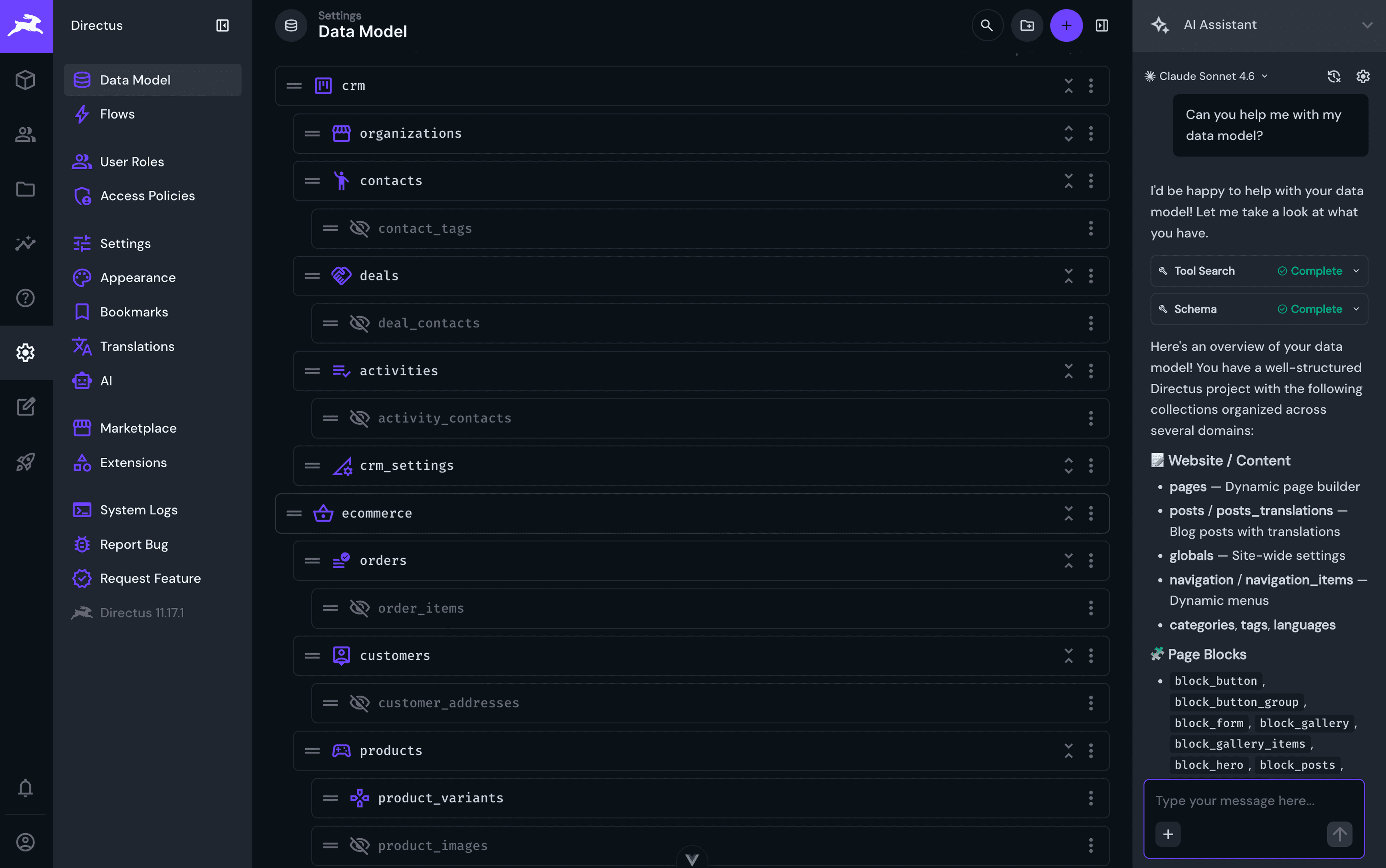
Directus Studio
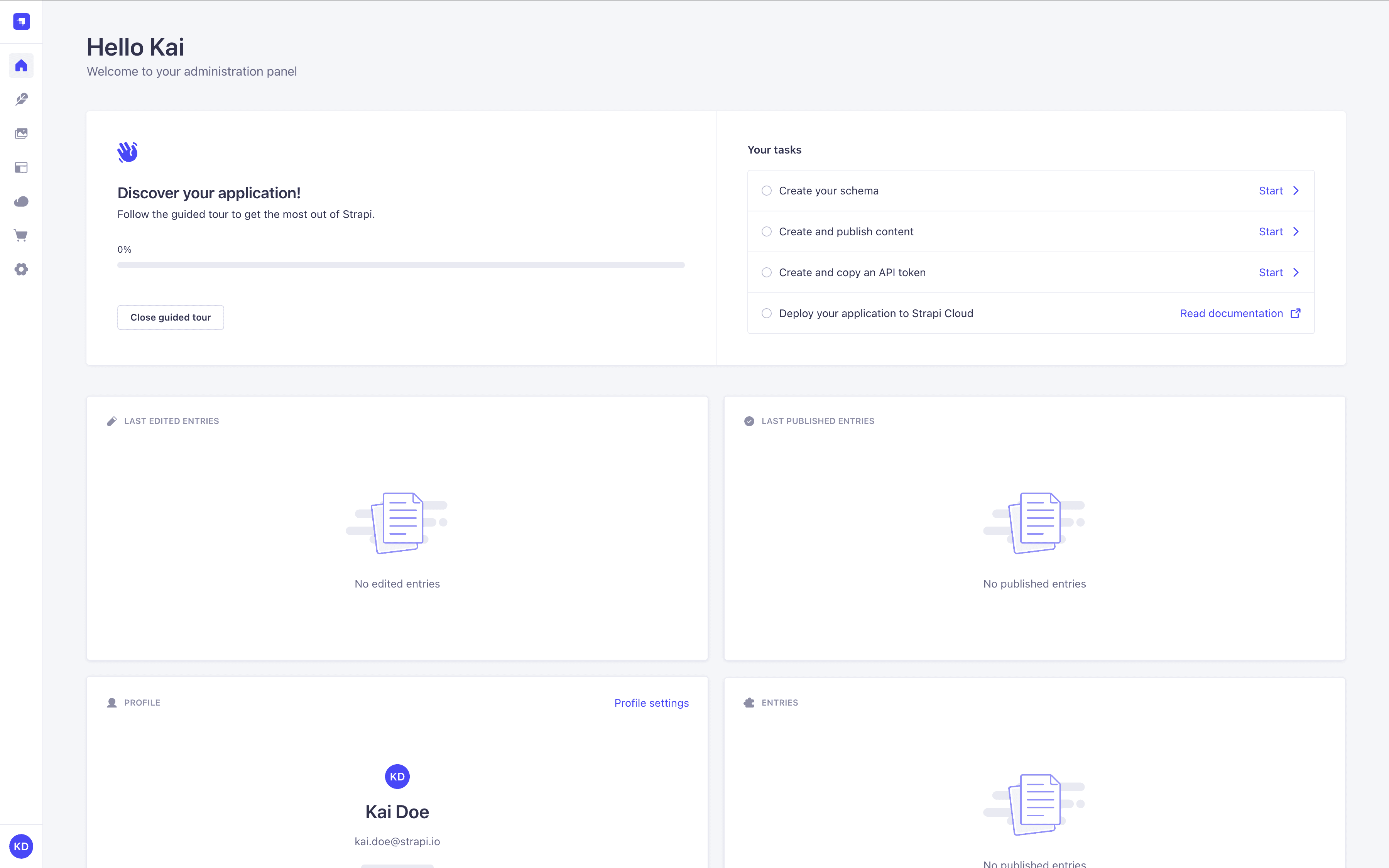
Strapi Admin Panel
Open source vs. source-available.
Strapi is MIT licensed. It is open source by the OSI definition. You can fork it, ship it inside a proprietary product, and modify it without permission.
Directus is distributed under a source-available license. Previously a Business Source License, Directus has now shifted to the MSCL, or Monospace to a custom Monospace license. See directus.io/license for the live terms.) The source code is fully readable and modifiable, and free to self-host for the vast majority of use cases. It is not open source in the OSI sense, and we don't claim it is.
For most teams, the practical day-to-day experience of using either tool as a self-hosted developer is the same: you read the code, you run the code, you ship the code, you don't pay anything for it.
The license difference matters when company policy, regulatory requirement, or principle specifically requires OSI-approved open source. In that case, Strapi is the right choice and Directus is not. Outside of that case, the license question is downstream of the architecture choice and the capability gaps below.
January 2, 2026
"Flexible, User-Friendly CMS with Full Control"
What they liked
Strapi stands out for its flexibility and ease of use as a headless CMS. Creating and managing content types is straightforward, and the APIs (REST and GraphQL) make it very easy to consume content from multiple websites and applications. I also really appreciate that Strapi is self-hosted, which gives full control over data, infrastructure, and deployment. The admin interface is clean and intuitive, allowing non-technical users to manage content efficiently, while developers can easily customize APIs, permissions, and business logic when needed.
What They Didn't
The main downside is that more advanced customizations, especially in the admin panel or when extending core functionality, can have a learning curve. Major version upgrades may require additional effort, particularly if you rely on plugins or custom code.
Nestor B.
Software Consultant
•
Mid-Market
December 19, 2024
"Directus is the GOAT"
What they liked
Directus thought of everything to make an extremely versatile tool! I have had the most amazing experience dealing with the team, they've supported us through and through and offered a product that is literally a blank slate for any use case, but with the bells & whistles unmatched by other products out there on the market for a fraction of the cost. I love using the data model, the flows, and of course the flexibility of extensions and configurations of not only the app but what it can power.
What They Didn't
The self-hosted install was a bit tricky to get setup but the incredible support team was able to get us through the issue.
Chrystal F.
Sr. Director, Content Engineering
•
Mid-Market
Content Modeling
Strapi and Directus take different approaches. Both can model the same things. The shape of the primitives differs.
Components in Strapi are reusable groups of fields. Think "SEO metadata" or "address" as a unit you define once and reuse across content types. Directus has groups, repeating field templates, and reusable field configurations that cover the same territory. Strapi names this primitive explicitly; Directus assembles it from more general database concepts. Both end at the same place.
Dynamic zones in Strapi let editors compose a page from a flexible list of component types. Directus uses Many-to-Any (M2A) relationships, which can do everything dynamic zones do plus arbitrary cross-collection composition (a single field that can reference items from any number of unrelated collections).
Strapi's primitive is more opinionated and quicker for the specific landing-page use case. Directus's primitive is more general and unlocks compositions Strapi can't express.
Because every collection in Directus is a real database table, the modeling primitives are the ones a database already gives you: tables, columns, foreign keys, junction tables. There's no abstraction hiding the schema. The same data is trivially queryable by other systems (analytics jobs, BI tools, other services, ML pipelines) without going through the CMS API.
Strapi's content-type abstraction is a layer over the database, which is cleaner if you only ever read your data through Strapi and friction if you don't.
The admin experience.
Directus ships the Studio, built in Vue 3 and framed as a workspace, not as a content-publishing tool. The same UI that lets a content editor edit a blog post lets an operations person build a dashboard, configure a workflow, manage permissions, or chat with the built-in AI Assistant.
Strapi ships the Admin Panel, built in React and shaped primarily around content management. It does that job well. It's clean, fast, and predictable. If your primary use case is "let editors create and publish content," Strapi's admin is purpose-built for that.
If your editors only edit content, Strapi's admin is more focused. If your team mixes content people, ops people, analysts, and AI agents who all need to work on the same backend, the Studio is built for that mix and Strapi's admin isn't.
Automation and workflows.
Directus has Flows, a visual automation builder. Drag together triggers, conditions, and operations to build pipelines that run on data changes, schedules, or webhooks. Non-developers can build moderately complex automations. Developers can drop into custom JavaScript at any step.
Strapi has lifecycle hooks. They're code. You write functions that fire before or after operations on your content types. They're well-documented and version-control well. They aren't visual.
If your team includes non-developers who want to build their own automations, Flows is a clear Directus win. If automations are owned end-to-end by engineers, Strapi's hooks are fine and arguably easier to manage in a typical developer workflow.
Realtime and database breadth.
Two capability differences that don't fit neatly elsewhere but matter at evaluation time.
Realtime APIs. Directus ships native WebSockets and GraphQL Subscriptions in the core. You can subscribe to changes on any collection and push live updates to clients without adding extra infrastructure. Strapi does not ship native realtime. You'd add a separate layer (Pusher, custom WebSocket server) or build it as a plugin.
Database support. Directus connects to Postgres, MySQL, MariaDB, SQLite, MSSQL, Oracle, and CockroachDB. Strapi supports Postgres, MySQL, MariaDB, and SQLite. The difference matters in two cases. First, if you're an enterprise running on MSSQL or Oracle (still common in financial services, government, and legacy estates), Directus connects directly and Strapi doesn't. Second, if you want a cloud-native distributed Postgres-compatible database (CockroachDB), Directus speaks it natively.
Neither of these is a niche concern. Realtime is table stakes for collaborative apps and live dashboards. Database breadth matters anywhere outside the standard MySQL or Postgres comfort zone.
AI.
Directus ships with a native AI Assistant inside the Studio. It's conversational and it takes action. It can create content, translate fields, summarize records, route items for review, and operate against your data with the same access policies as a human user. It's not a separate "AI mode," it's part of the same workspace.
Directus also runs a native MCP server. External AI tools (Claude Desktop, Cursor, ChatGPT, your own agent) can connect and work with the same data using the same access policies. AI is treated as another API consumer.
Strapi has third-party community plugins for AI features. The most common is an OpenAI plugin for content generation. There's no native MCP server. AI is opt-in via the plugin marketplace and the quality varies plugin to plugin.
If "AI agents that take action on my content under our existing permission rules" is part of your roadmap, Directus is built for that. If AI is a "would be nice eventually" item, Strapi's plugin route is workable for a while.
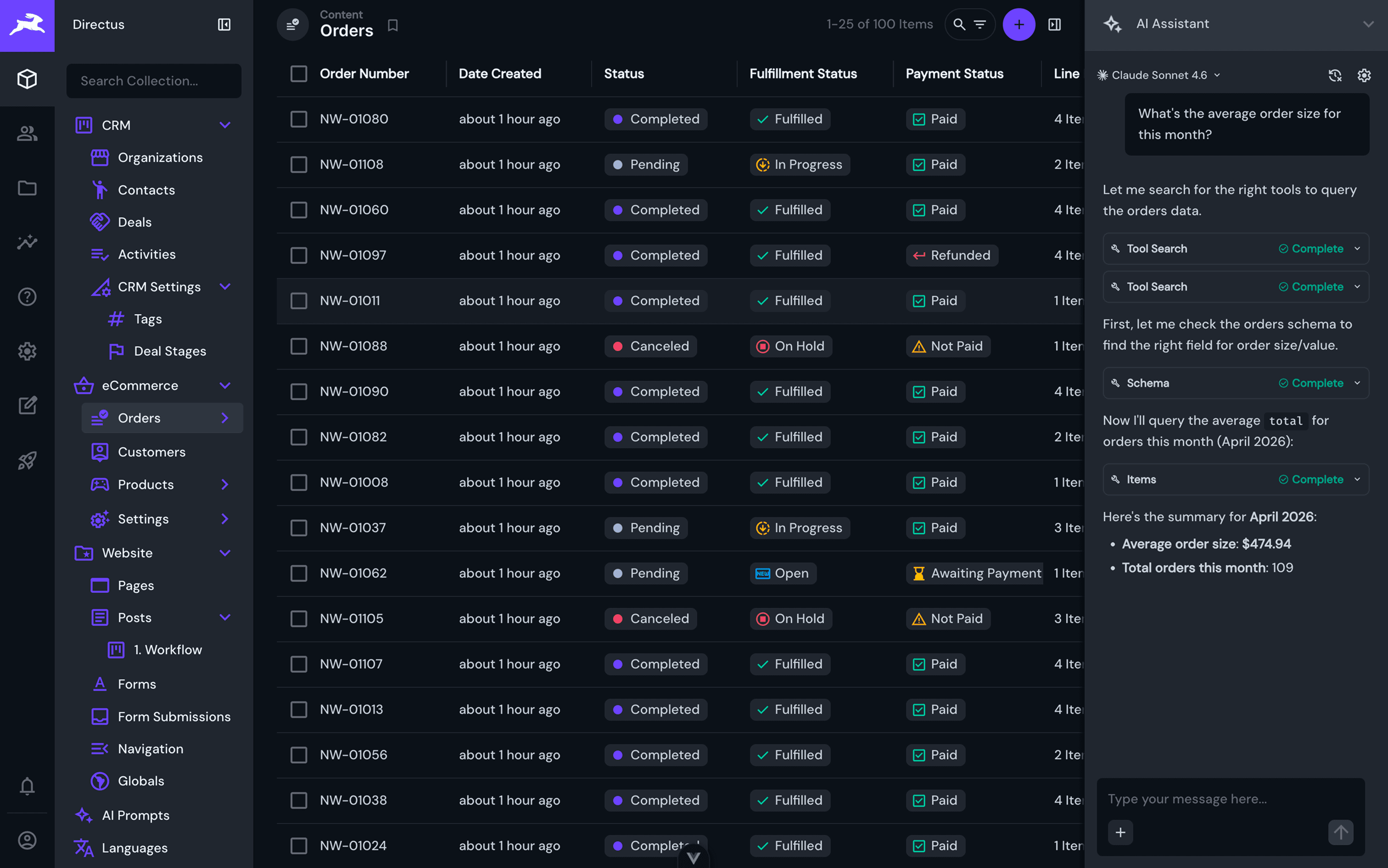
The Assistant runs against the same data layer with the same permissions as a human user. Not a separate AI mode.
The honest answer is most teams don't choose between these tools on features. They choose on whether they want to think in terms of a database or in terms of content types. Pick the one that matches how your team thinks.
Developer experience.
Both tools get you to a working backend in minutes if you have Docker running.
npx
directus-template-cli@latest init
Directus
npx
create-strapi-app@latest my-project
Strapi
Both have CLIs. Both have TypeScript SDKs. Both have docs that range from solid to occasionally thin in specific corners.
Strapi's community is larger by raw count. It's been around longer in its current shape and the MIT license has community-growth effects. There are more Stack Overflow answers, more YouTube tutorials, more "how do I do X in Strapi" search results.
Directus has a tighter, more concentrated community around the Discord, the forum, and a smaller but active set of contributors. Quality of in-house support tends to be higher. Volume of community-generated content is lower.
What it actually costs.
Both tools have a free self-hosted tier and a managed cloud product with paid tiers above it.
Self-hosting: Free for both. You bring infrastructure, do operations, take on backups and upgrades.
Managed cloud: Both have starter, team, and growth-style tiers running from low double-digits to a few hundred dollars per month, with enterprise pricing custom-quoted above that.
Enterprise: Both have enterprise tiers with SSO, audit logs, dedicated support, and SLAs.
The thing that varies more than headline price: what's gated to which tier. Field-level permissions, environment management, SSO, and granular audit logs are common dividing lines, and they sit at different tiers in each tool. Compare the feature matrix at the tier you'll actually be on, not the pricing-page hero number.
Neither is perfect.
We promised this and we'll keep our word.
Three areas where Directus is weaker | Three areas where Strapi is weaker |
|---|---|
Strapi is OSI-approved open source. Directus is source-available. If your policy or principle requires OSI open source, this is the deciding factor. | Strapi expects to own the database schema. Existing-database scenarios, or databases shared with non-Strapi services, are friction at best and a non-starter at worst. |
Strapi's plugin marketplace has more entries. | Strapi's admin is content-publisher-shaped. If your team needs a shared workspace for content, ops, analytics, and AI, the Studio is built for that and Strapi's admin isn't. |
Strapi has more community-generated content (tutorials, courses, blog posts, Stack Overflow answers). | Narrower database support: no MSSQL, no Oracle, no CockroachDB. Common dealbreaker for enterprise, finance, government, or anyone outside the MySQL/Postgres comfort zone. |
Who each is usually best for.
Strapi is usually best for | Directus is usually best for |
|---|---|
Teams that require OSI-approved open source as a hard policy or principle requirement | Teams with an existing SQL database, or teams who want a database usable by other tools, not locked behind one CMS |
Content-heavy projects whose primary daily work is composing flexible page layouts with the dynamic-zones primitive | Teams running on MSSQL, Oracle, CockroachDB, or any database Strapi doesn't support |
Teams that prefer code-first schema definitions in JSON files and version-controlled migrations | Teams where content, operations, analytics, and AI agents all work on the same governed data layer |
Greenfield projects where Strapi owns the database from day one and no other service shares it | Teams where non-developers own real workflows: dashboards (Insights), visual automations (Flows), AI-assisted operations |
Teams running MySQL, MariaDB, Postgres, or SQLite (the four databases Strapi supports) | Teams that prefer a database-first mental model and want their schema to remain a first-class artifact |
Projects where the admin is used only by content editors, with no need for native dashboards, automation, AI, or realtime | Projects where AI Assistant or native MCP server are part of the plan, not a "we'll plug something in later" item |
Migration notes.
Strapi to Directus: Easier than the reverse. Your existing database is the starting point. Point Directus at the database Strapi was using, and the Studio shows your collections and fields based on the schema Strapi created. You'll lose Strapi-specific abstractions (dynamic zones map to Many-to-Any in Directus), and you'll need to rebuild any Strapi plugins as Directus extensions.
Directus to Strapi: Harder. Strapi expects to model the schema, so you'd recreate your content types in Strapi and migrate data over. If you've been using database features Strapi doesn't speak natively (custom Postgres types, advanced indexes, multi-database joins, materialized views), expect rework.
In both directions, custom code (extensions, plugins, hooks, lifecycle handlers) doesn't transfer. Reimplement in the other tool's extension model.
Common questions.
Is Strapi better than Directus?
Neither is "better" in a general sense. They're built for different relationships to the database. Strapi is content-type-first and code-first. Directus is database-first and visual-first. The right answer is the one that matches how your team thinks about data.
Is Directus open source?
No. Directus is source-available under the Business Source License. The source is fully readable and free to self-host for the vast majority of use cases, but it isn't open source by the OSI definition. Strapi is MIT licensed and is open source. If OSI-approved open source is a hard requirement, choose Strapi.
Can I use the same database for both Strapi and Directus?
You can point Directus at a database that Strapi created and Directus will read the schema. You can't do the reverse. Strapi expects to own the schema and won't pick up tables that exist outside its model.
Does Strapi have an AI assistant like Directus?
Not natively. There are third-party plugins for AI features (most commonly OpenAI-based content generation). Directus ships an AI Assistant inside the Studio and runs a native MCP server, so external AI agents can connect using the same access policies as human users.
Which has better developer experience?
Both are competent. Strapi has a larger community and more third-party content. Directus has a more cohesive Studio, more native capabilities out of the box (Flows, Insights, AI Assistant, MCP server, realtime APIs), and broader database support. DX preference depends on whether you value community volume or native capability density.
Which scales better at enterprise size?
Both scale. The bottleneck in either case is your database, not the layer on top of it. At very large scale (billions of rows, heavy read traffic), the answers depend on database choice, infrastructure, and caching strategy, not on Strapi vs. Directus.
Is one cheaper than the other?
Self-hosting is free for both. Managed cloud pricing lands in similar ranges. The question that matters more: which features you need are gated to which tier? That answer is different per project. Compare the feature matrix at the tier you'll actually pay for.
Are Directus and Strapi the only options?
No. The headless backend space includes Payload, Sanity, Contentful, Hygraph, Keystone, Builder.io, and others, plus database-as-a-service tools like Supabase that overlap from a different angle.