Comparison
Sanity vs. Directus
Architecture, content modeling, admin UI, automation, AI, and pricing compared.

Matt Minor
Senior Director, Growth
A note from Directus
Yes, this is a Directus vs Sanity page written by Directus. Yes, that's we know that's absurd. Every vendor publishes one of these and ranks themselves first, so we have to publish ours or you won't find one that mentions us at all. So, if we have to play this game, we'd rather play it differently. What follows is the most honest comparison we could write.
Two backends, two opposite directions.
Sanity and Directus both give you a backend with auto-generated APIs and an admin UI on top of structured content. They get there from opposite directions.
Sanity is an API-first SaaS: your content lives in Sanity's hosted Content Lake, queried through GROQ (their custom query language) or GraphQL, served from their CDN. The admin (Sanity Studio) is open source and self-deployed, but the data behind it is Sanity-hosted.
Directus is a self-hosted (or managed) platform that sits on top of any SQL database you bring or spin up.
Pick Sanity if you want a SaaS content backend with a deeply customizable Studio, GROQ as a powerful query language, and a strong JAMstack ecosystem.
Pick Directus if you want to own your data in a real SQL database, self-host (or use Directus Cloud), pay predictable infrastructure costs instead of API-call pricing, and get native dashboards, visual automation, AI Assistant, MCP server, and realtime APIs out of the box.
The feature-by-feature view.
A few rows do most of the work. Hosting model (self-host vs. Content-Lake-only) is the architectural fork. Where data lives (your database vs. their hosted Content Lake) is the data-sovereignty question. GROQ is Sanity's distinct technical advantage. Real-time multiplayer is built into Sanity Studio at a fidelity Directus matches partially through presence. Native AI, MCP, Flows, Insights are capabilities Directus ships natively that Sanity ships in narrower form or doesn't ship at all.
Dimension | Directus | Sanity |
|---|---|---|
License | Source-available (custom Monospace license) | Studio is MIT; Content Lake is proprietary SaaS |
Hosting | Self-host (Docker, Node) or Directus Cloud | Studio self-hosted; Content Lake SaaS only |
Schema Philosophy | Reads your existing SQL schema | Schema defined as JS/TS in the Studio repo |
Supported Databases | Postgres, MySQL, MariaDB, MSSQL, SQLite, Oracle, CockroachDB | N/A (Content Lake only) |
API Output | REST, GraphQL, WebSockets, GraphQL Subscriptions | REST, GraphQL, GROQ, Listen API |
Admin UI | The Studio (Vue 3) | Admin Panel (React, inside Next.js) |
Query Language | SQL (under the hood), filter syntax | GROQ (custom), GraphQL |
Modeling Primitives | Collections, fields, relationships, M2A, translations | Documents, references, arrays, Portable Text |
Real-Time Multiplayer | Presence, Field Locking + Live Updates | Built-in multiplayer (cursors, presence, instant sync) |
Managed Cloud | Directus Cloud | No |
Where Data Lives | Your SQL database | Sanity's Content Lake, vendor-controlled |
Native Realtime APIs | WebSockets, GraphQL Subscriptions | Listen API (Content Lake-specific) |
Native AI Assistant | Yes, in the Studio | Sanity Create, AI Assist (authoring-focused) |
Native MCP server | Yes | No |
Visual Automation | Flows | No (webhooks + Sanity Functions) |
Native Dashboards | Insights | No |
Asset CDN | Bring your own | Built-in CDN with image transforms |
Localization | Translations on any field, all tiers | Plugin-based |
Pricing model | Per-environment / per-seat or self-hosted free | Per-seat + API-call / document / bandwidth quotas |
The main architectural difference.
This is the one section worth reading carefully, because every other comparison on this page makes more sense after it.
API-first Saas.
Your documents live in Sanity's hosted Content Lake. You define schemas in JS/TS inside the Sanity Studio repo (which you self-host), but the data behind those schemas is stored, queried, and served by Sanity's infrastructure. You read content through their APIs (REST, GraphQL, or GROQ). The Studio is open source. The Content Lake is not, and you don't run it.
Database-first.
You point it at any SQL database (existing or empty), and it reads the schema it finds. Tables become collections. Columns become fields. There's no separate schema layer. The database is the schema. Change something outside of Directus, the change shows up in the Studio on next refresh. Directus Cloud is available for managed hosting, but the database remains a real database you can connect anything else to.
If your top priority is "I want a hosted content backend, I never want to think about databases, and I want a customizable admin that can be reshaped to fit any editorial workflow," Sanity is built for that. The combination of hosted Content Lake plus self-deployable, fully customizable Studio is a real Sanity sweet spot.
If your top priority is "my data should live where I can query it directly with SQL, run analytics against it, share it with services that aren't a CMS, and not be locked into a vendor's API," Directus is built for that and Sanity isn't. With Sanity, every read and write goes through GROQ, GraphQL, or REST. There's no SQL to run against the Content Lake, no warehouse-native joins, no sibling service sharing the same tables.
If you have hard data-residency, on-premise, air-gapped, or regulatory constraints (GovCloud, healthcare, financial services, EU sovereignty rules), self-hosting may not be optional. Sanity's Content Lake is SaaS-only, so it's a non-starter in those scenarios. Directus self-hosts in any environment you control.
Neither approach is wrong. They're built for different relationships to your content and your infrastructure.
The two admin UIs, side by side.
Both shipped polished interfaces. Different shapes, different jobs. Here's what you'd see ten seconds after logging in.
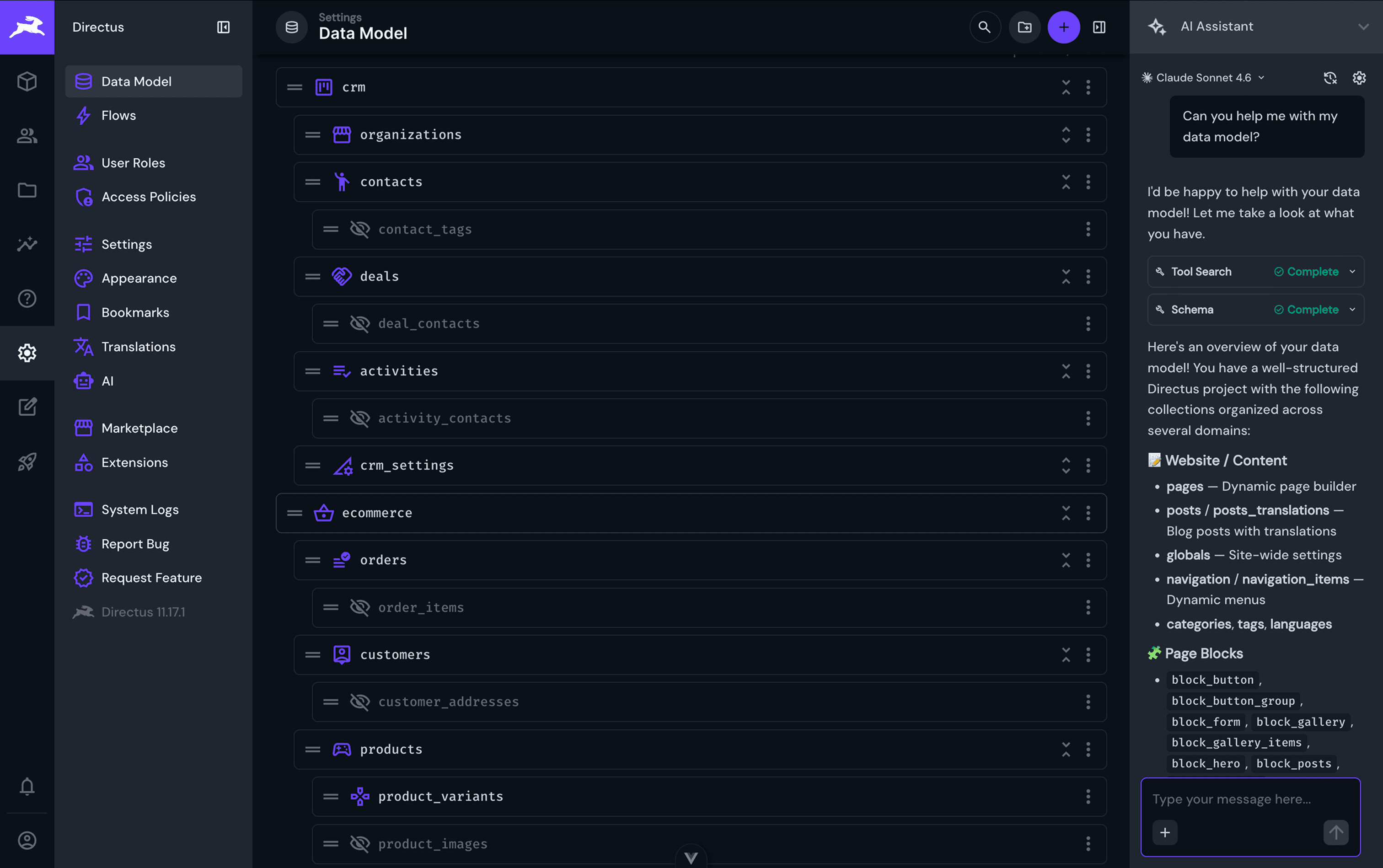
Directus Studio
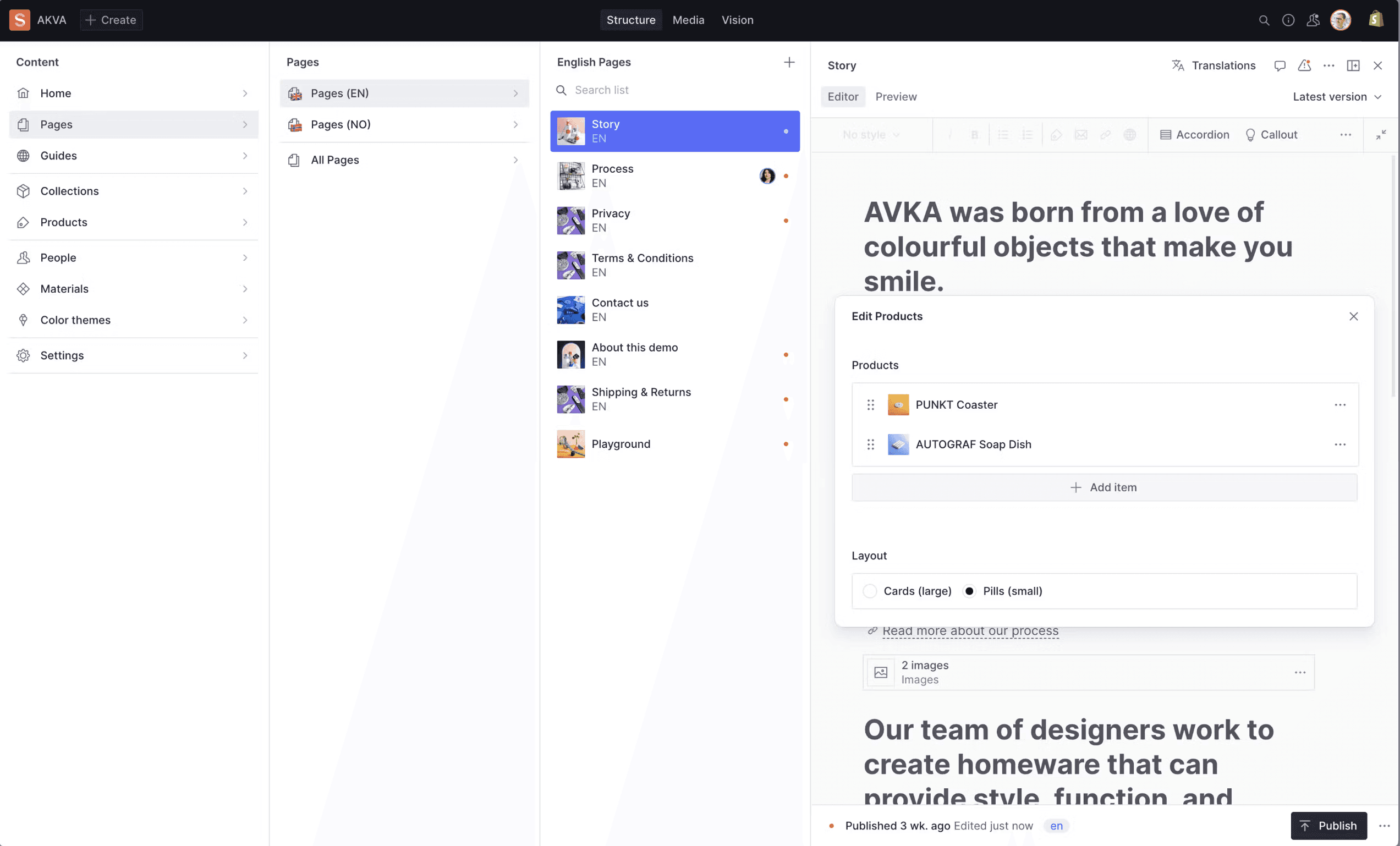
Sanity Studio
Open Studio, hosted backend.
Sanity Studio is MIT licensed. The Studio code is open source, you self-host it, you customize it, you deploy it wherever you want. The Content Lake (the hosted data layer) is proprietary, closed-source SaaS. You can read and fork Sanity Studio. You can't read or run the Content Lake.
Directus is distributed under a source-available license. (The license is currently moving from the Business Source License to a custom Monospace license. See directus.io/license for the live terms.) The source code is fully readable and modifiable, and free to self-host for the vast majority of use cases. It is not open source in the OSI sense, and we don't claim it is.
If your hard requirement is OSI-approved open source across the whole stack (admin and data layer both), neither tool fully meets that bar (Strapi or Payload would). Sanity is the closest "open Studio, closed backend" option. Directus is the closest "everything source-available, all self-hostable" option. They're different shapes of "open."
November 7, 2024
"Sanity gives our team the velocity we need"
What they liked
I like how customizable and easy it is to implement complex needs for our editors. From idea to implementation is usually done in a very short time. I like features that are just expected to be part of such a solution as Sanity, without having to reinvent to wheel for our editors every time. E.g scheduled publishing, comments etc. The SLA customer support we have at the Norwegian welfare and labout department is outstanding. The Sanity team is always happy to help and usually has an answer to our questions.
What They Didn't
I am not too fan of Groq. I find it quite hard at times. I also think it is quite hard to migrate data.
Sindre M.
Senior Developer
•
Mid-Market
December 19, 2024
"Directus is the GOAT"
What they liked
Directus thought of everything to make an extremely versatile tool! I have had the most amazing experience dealing with the team, they've supported us through and through and offered a product that is literally a blank slate for any use case, but with the bells & whistles unmatched by other products out there on the market for a fraction of the cost. I love using the data model, the flows, and of course the flexibility of extensions and configurations of not only the app but what it can power.
What They Didn't
The self-hosted install was a bit tricky to get setup but the incredible support team was able to get us through the issue.
Chrystal F.
Sr. Director, Content Engineering
•
Mid-Market
Content modeling.
Both tools model structured content well. The shape of the primitives differs.
Documents in Sanity are typed entries defined by schema files in your Studio repo. References connect documents to each other. Arrays let you compose documents from blocks of varied types. Portable Text is Sanity's structured rich-text format: a tree of typed blocks rather than HTML or markdown. It's well-designed and is one of the genuine reasons content-heavy teams pick Sanity.
Collections in Directus are real database tables. Fields are columns. Relationships are foreign keys. Many-to-Any (M2A) lets a single field reference items from any number of unrelated collections, useful for flexible page composition, polymorphic relationships, and arbitrary cross-collection joins. Because the model is the database, the same data is trivially queryable by any system that speaks SQL.
Rich text. Portable Text is more opinionated and is better suited to teams who publish the same content to many surfaces (web, mobile, voice). Directus uses standard rich-text and WYSIWYG fields, plus repeatable groups and M2A for structured composition. More conventional, fine for teams whose primary output is a web front-end.
Localization. Sanity handles localization via plugins or schema-level locale variants. There's no single canonical pattern. Directus stores translations as related rows in a translations table that can hang off any field, available natively on every tier without plugins.
GROQ. Sanity's distinct technical contribution. A query language specifically designed for nested document graphs. You can project, filter, join, transform, and aggregate in a single query in a way that feels closer to JSON shaping than SQL. For teams that do a lot of complex content queries, GROQ is genuinely powerful. Directus speaks SQL under the hood and exposes filter syntax over REST and GraphQL — both well-established but verbose by comparison for nested projections.
The admin experience.
Directus ships the Studio, built in Vue 3 and framed as a workspace, not as a content-publishing tool. The same UI that lets a content editor edit a blog post lets an operations person build a dashboard, configure a workflow, manage permissions, or chat with the built-in AI Assistant.
Sanity ships Sanity Studio, built in React, self-hosted, and fully customizable. You write your schemas in JS/TS, you can replace any component in the Studio with your own React, you can ship custom plugins, you can theme it per project. Real-time multiplayer (cursors, presence, instant sync) is built in, a genuine ergonomic win for teams where multiple editors regularly work on the same content.
If your team is editorial-heavy with developers willing to invest in customizing the Studio, and multiple editors collaborate on the same document in real time, Sanity Studio is purpose-built for that. If your team mixes content people, ops people, analysts, AI agents, and developers who all need to work on the same governed data layer, the Directus Studio is built for that mix and Sanity isn't.
Automation and workflows.
Directus has Flows, a visual automation builder. Drag together triggers, conditions, and operations to build pipelines that run on data changes, schedules, or webhooks. Non-developers can build moderately complex automations. Developers can drop into custom JavaScript at any step.
Sanity does not ship a visual automation builder. Automation comes from three places: webhooks (fire on document changes), Sanity Functions (their serverless functions tied to Content Lake events), and custom Studio plugins. All code-based; none visual.
If your automations are code-owned and your team prefers schema-and-functions-as-code, Sanity's model is clean and modern. If your team includes non-developers who want to build their own automations (content routing, scheduled tasks, multi-step approvals, integrations), Flows is a clear Directus win.
Realtime, delivery, multiplayer.
Three capabilities that show up differently and matter at evaluation time.
Real-time multiplayer editing. Sanity ships built-in real-time multiplayer in the Studio: live cursors, presence, instant sync of edits across collaborators. Directus has presence indicators and live updates on records, but Sanity's multiplayer experience is more polished and is a real differentiator for editorial teams working concurrently on the same documents.
Realtime APIs. Directus ships native WebSockets and GraphQL Subscriptions in the core. Subscribe to changes on any collection and push live updates to clients without adding infrastructure. Sanity ships the Listen API, which streams Content Lake changes to subscribed clients. Both work. The shapes are different: Directus uses standard protocols any client would use the same way; Sanity's Listen API is specific to the Content Lake.
Content delivery and assets. Sanity ships a global CDN with on-the-fly image transformations baked in. For a marketing site that serves content globally, "their CDN handles it" is a genuine reduction in operational scope. Directus does not ship a built-in global CDN. You bring your own caching layer (CloudFront, Cloudflare, Fastly) and your own asset CDN (S3+CloudFront, Cloudinary, Bunny). Directus ships asset transformations and signed URLs natively, but the global edge layer is your problem.
AI.
Directus ships with a native AI Assistant inside the Studio. It's conversational and it takes action. It can create content, translate fields, summarize records, route items for review, and operate against your data with the same access policies as a human user. It's not a separate "AI mode," it's part of the same workspace.
Directus also runs a native MCP server. External AI tools (Claude Desktop, Cursor, ChatGPT, your own agent) can connect and work with the same data using the same access policies. AI is treated as another API consumer.
Sanity has been adding AI features: Sanity Create (AI-first authoring tool) and AI Assist (in-Studio drafting, translation, and metadata help). These are scoped primarily to authoring assistance inside the Studio. There's no native MCP server. The capabilities are useful for editorial teams looking to speed up writing, but they're scoped to authoring rather than "AI agents that take action under your existing permissions across the whole data layer."
If "AI agents that take action on my content under our existing permission rules" is part of your roadmap, Directus is built for that. If "AI helps my editors draft and translate faster" is the goal, Sanity's AI features are worth evaluating on their own merits.
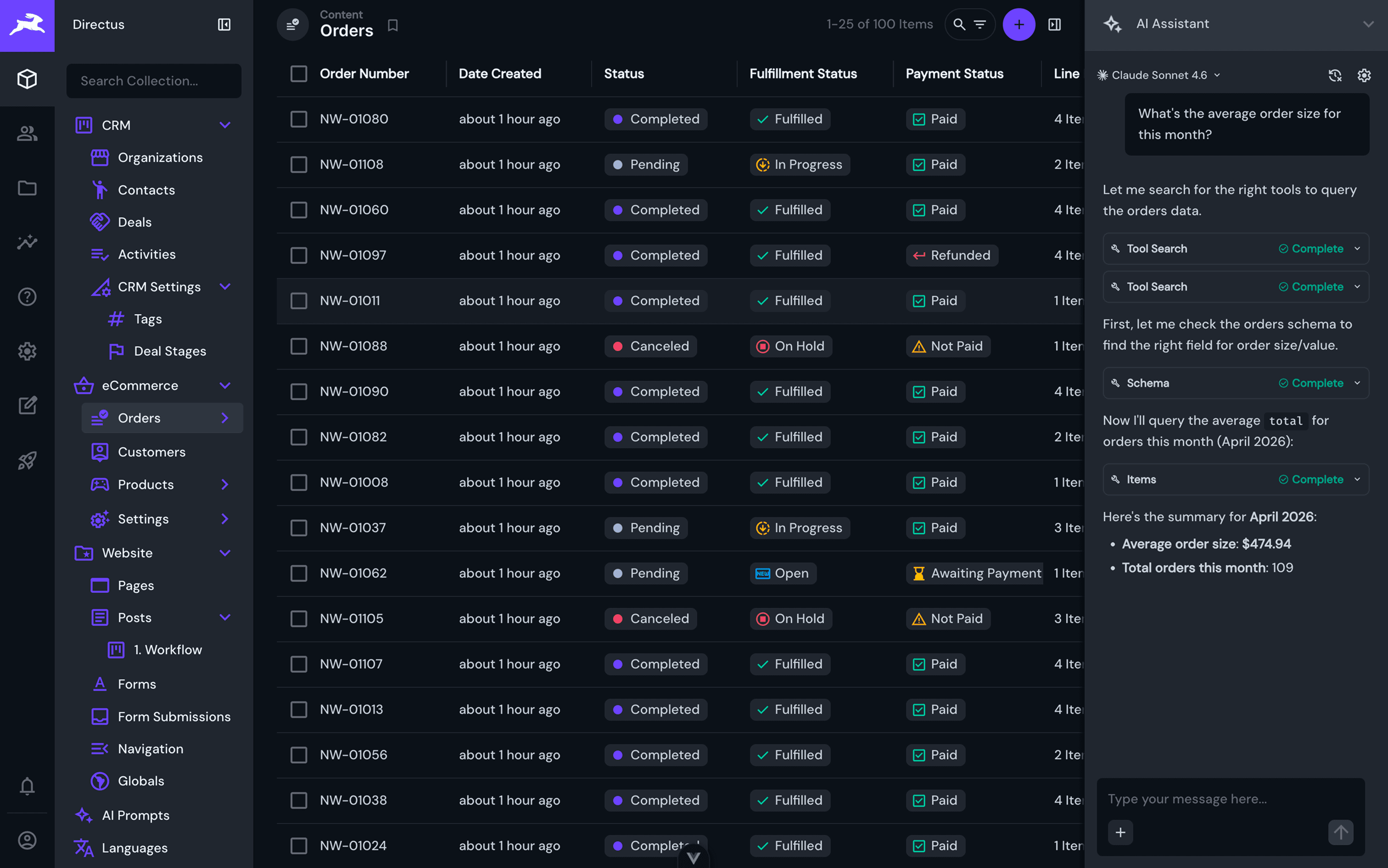
The Directus AI Assistant runs against the same data layer with the same permissions as a human user. Not a separate AI mode.
The honest answer is most teams don't choose between these tools on features. They choose on whether they want their content to live in a vendor's Content Lake queried via GROQ, or in a SQL database they own. Pick the one that matches.
Developer experience.
Both tools get you to a working backend in minutes.
npx
directus-template-cli@latest init
Directus
npx
create sanity@latest
Sanity
Both have CLIs. Both have TypeScript SDKs. Sanity's docs are mature and have been refined for years; the GROQ documentation in particular is one of the better query-language references in the category.
GROQ is Sanity's distinct DX feature. For teams that write a lot of nested content queries, the conciseness and expressiveness genuinely speed up day-to-day work. Directus uses SQL on the database side and standard REST/GraphQL filter syntax on the API side — both well-established but more verbose for nested projections.
Studio customization is Sanity's other distinct DX feature. The level of control over the editor UI is genuinely high. Teams that want a custom editorial experience can build one without forking the Studio.
Directus has a TypeScript SDK with generated types, a more cohesive UI workspace with native AI, automation, dashboards, and realtime out of the box, and broader native capability density. Different DX shape: more capability shipped in, less customization of the editor surface.
Schema as code. Both support it. Sanity's schemas are JS/TS files in the Studio repo, version-controlled and code-reviewed naturally. Directus supports it through Schema Snapshots: you snapshot your database schema (since the database IS your schema in Directus) and apply snapshots to other environments. Both work; the mental model differs.
What it actually costs.
Self-hosting (Directus only): Free. You bring infrastructure, do operations, take on backups and upgrades. Sanity has no self-host option for the Content Lake.
Free / community tier: Both have one. Directus self-hosted is free indefinitely with all core features. Sanity's free tier is generous for individuals and small projects but caps documents, users, API requests, and asset bandwidth. The caps matter sooner than teams expect once a project has real traffic or multiple editors.
Managed cloud: Directus Cloud has starter, team, and growth-style tiers running from low double-digits to a few hundred dollars per month. Sanity runs on a per-seat plus quota model. Growth-tier seats sit in the mid-double-digits per user per month, with overages on API calls, bandwidth, and document counts on top.
The thing that varies most: Sanity's pricing is per-seat plus metered on API calls, bandwidth, and documents. Directus pricing on Cloud is per-environment and per-seat without API-call metering, and self-hosted is your-infrastructure-cost-and-nothing-else. Teams routinely under-estimate Sanity's total cost at scale because the metered line items grow with traffic and content volume, not with users. Model the total bill against your real expected traffic, document count, and seat count at your one-year scale, not the headline tier.
Enterprise: Both have enterprise tiers with SSO, audit logs, dedicated support, and SLAs. Both will quote you.
Neither is perfect.
We promised this and we'll keep our word.
Three areas where Directus is weaker | Three areas where Sanity is weaker |
|---|---|
Sanity Studio is fully customizable in ways that go beyond Directus's extension primitives. If your team wants to deeply reshape the editorial UI, Sanity gives you more direct control over the React tree. | The Content Lake is SaaS-only. No self-host, no on-prem, no air-gapped, no VPC deployment. Hard regulatory or sovereignty requirements rule it out for the data layer. |
Sanity ships real-time multiplayer editing (live cursors, presence, instant sync) as a polished, default experience. Directus has presence and live updates, but the multiplayer fidelity is lower. | No real database access. Your data lives in their cloud as documents, queryable only through GROQ, GraphQL, or REST. No SQL, no warehouse-native joins, no analytics jobs against the raw store, no sibling services sharing the same tables. |
GROQ is a powerful query language for nested document graphs. For teams that do a lot of complex content queries and have bandwidth to learn a new query language, GROQ is more concise than SQL or GraphQL. | Migration off Sanity is significant work. Documents are in Sanity's content model, accessed through Sanity's APIs, and exporting at scale takes engineering effort, especially for Portable Text content. |
Who each is (usually) best for.
Sanity is usually best for | Directus is usually best for |
|---|---|
Teams that want a hosted content backend and don't want to operate a database | Teams who want their content data to live in a SQL database they own, queryable by any service that speaks SQL |
Teams whose editorial workflow involves multiple editors collaborating in real time on the same documents | Teams with hard requirements around self-hosting, on-premise, air-gapped, EU data sovereignty, or regulated-industry compliance |
Developers who want to deeply customize the admin UI and treat the Studio as a fully bespoke React app | Teams where content, operations, analytics, and AI agents all need to work on the same governed data layer |
Teams who write a lot of nested content queries and would rather use GROQ than SQL or verbose GraphQL | Teams where non-developers own real workflows: dashboards (Insights), visual automations (Flows), AI-assisted operations |
Projects already standardized on the Sanity JAMstack ecosystem (Visual Editing, Presentation, starters, integrations) | Projects that need standard realtime APIs (WebSockets, GraphQL Subscriptions) usable from any client, not a vendor-specific Listen API |
Teams whose primary integration is "front-end developers consume the Content Lake APIs" and not "shared data layer across services" | Projects where AI Assistant or native MCP server are part of the plan, not a "we'll add AI authoring later" item |
Migration notes.
Sanity to Directus: Doable and well-trodden. The standard path: export your Sanity dataset using their CLI (sanity dataset export), transform the NDJSON document stream into a relational schema (document types become collections, references become foreign keys, Portable Text content needs a deliberate translation decision (store as JSON in a column, normalize into structured tables, or render to HTML/markdown) pick the one that matches your downstream consumers), and import into your SQL database. Plugins don't transfer; rebuild Studio customizations as Directus extensions. Webhooks reattach to Flow triggers. Plan the Portable Text translation carefully; it's the migration step that deserves the most engineering attention.
Directus to Sanity: Harder. Sanity's document model is more opinionated than a SQL schema, and any database features you've used (custom Postgres types, advanced indexes, M2A, multi-database joins, materialized views, raw SQL access) don't exist in Sanity. You'd remodel your schema as Sanity documents and migrate data through the Mutation API. Anything outside Sanity's document model (analytics queries, sibling services touching the database, scheduled jobs) needs to be re-architected to live somewhere else.
In both directions, custom code (extensions, plugins, hooks, Functions, Flows) doesn't transfer. Reimplement in the target tool's extension model.
Common questions.
Is Sanity better than Directus?
Neither is "better" in a general sense. They're built for different problems. Sanity is an API-first SaaS content backend with a customizable Studio. Directus is a self-hostable backend platform built around your existing or new SQL database. The right answer is the one that matches your team's operating model, your data-sovereignty requirements, and your cost expectations.
Is Directus open source?
No. Directus is source-available, currently transitioning from the Business Source License to a custom Monospace license. The source is fully readable and free to self-host for the vast majority of use cases, but it isn't open source by the OSI definition. Sanity Studio is MIT licensed (open source), but the Content Lake is proprietary closed-source SaaS. If OSI-approved open source is a hard requirement across the whole stack, neither tool fully meets it.
Can I self-host Sanity?
You can self-host Sanity Studio (the admin). You cannot self-host the Content Lake (the data layer). Your documents live in Sanity's cloud. There is no self-host, on-prem, or air-gapped option for the Content Lake at any tier.
What is GROQ?
GROQ (Graph-Relational Object Queries) is Sanity's custom query language designed for nested document graphs. It's compact and expressive for shaping JSON output from related documents. Directus uses SQL under the hood and exposes standard REST/GraphQL filter syntax. Both work for content queries; GROQ is more concise for nested projections, SQL is more general-purpose and works outside the CMS too.
Does Sanity have an AI Assistant like Directus?
Sanity has been shipping AI features: Sanity Create (AI-first authoring) and AI Assist (in-Studio drafting and translation help). Both are scoped to authoring assistance inside the Studio. There's no native MCP server. Directus ships an AI Assistant inside the Studio that takes action against your data layer with the same access policies as a human user, plus a native MCP server external AI tools can connect to.
Which has better developer experience?
Both are competent. Sanity has GROQ, deeply customizable Studio, and a large JAMstack ecosystem of starters and integrations. Directus has a more cohesive Studio with more native capabilities out of the box (Flows, Insights, AI Assistant, MCP server, realtime APIs), full database access, and a self-host option. DX preference depends on whether you value custom-Studio depth and GROQ, or native capability density and full-stack control.
Is one cheaper than the other?
At small scale, Directus self-hosted is materially cheaper (free + your infrastructure cost). At medium scale, Directus Cloud and Sanity's paid tiers land in similar headline ranges, but Sanity's per-seat plus metered API/bandwidth/document pricing pushes total cost higher than the headline. Directus's per-environment and per-seat model scales more predictably.
Are Directus and Sanity the only options?
No. The headless backend space includes Strapi, Payload, Contentful, Hygraph, Keystone, Builder.io, and others, plus database-as-a-service tools like Supabase that overlap from a different angle.